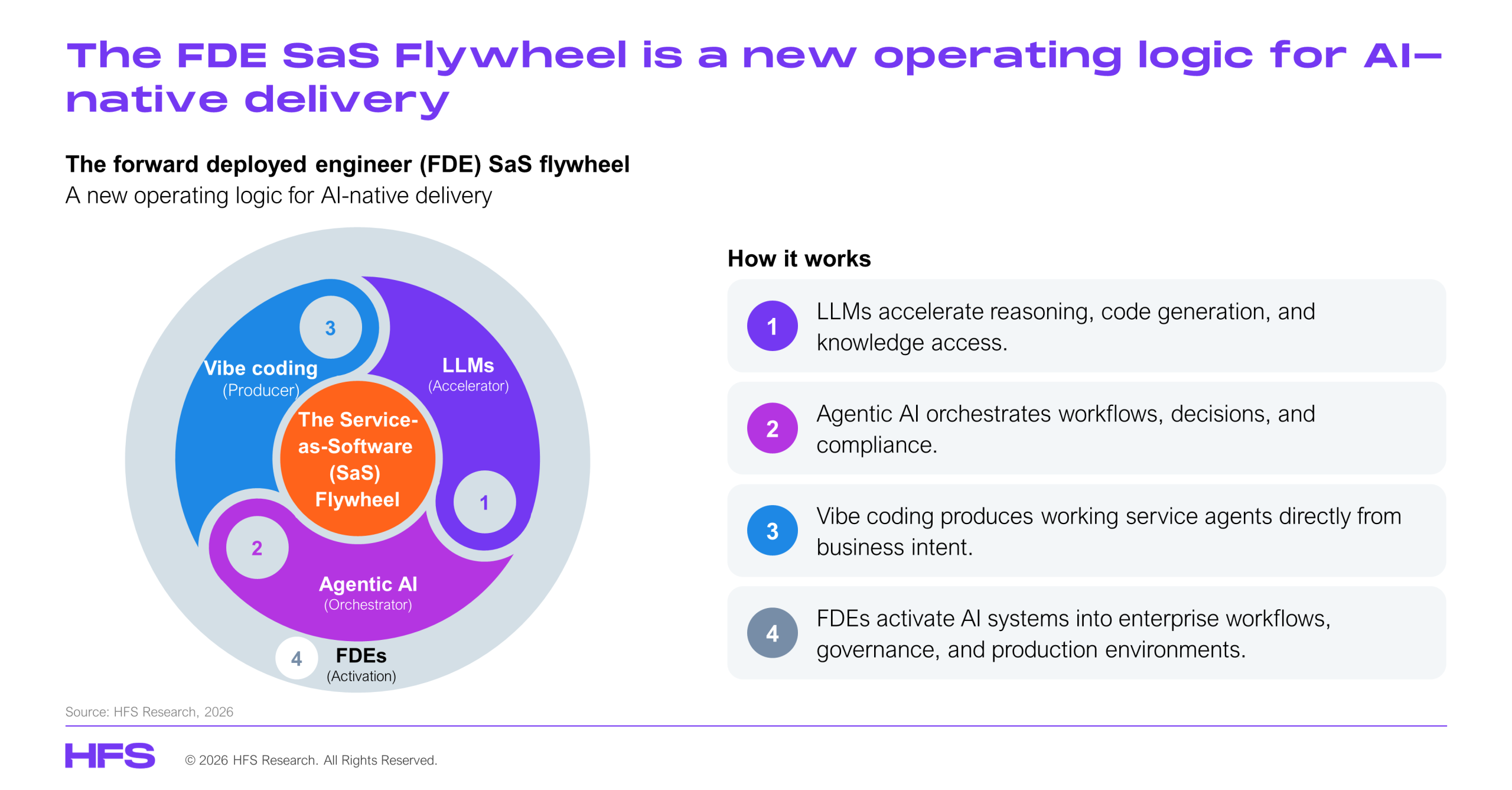
Enterprise AI stalls not from weak models but a missing FDE layer: engineers embedded in production to govern systems, wire data permissions, and own compliance architecture.
Key Takeaways
HFS frames FDE as the fourth accelerant in the Services-as-Software Flywheel, alongside LLMs, agentic AI, and vibe coding.
Palantir’s AIP Bootcamps compress deployment from POC to live production workflow in one to five days using FDE teams with real data and real controls.
FDE owns ontology design, decision rights mapping, audit trails, escalation paths, and continuous drift monitoring rather than the LLM vendor.
Vibe coding without FDE governance produces fragmented AI estates: redundant logic across silos, compliance exposure, and an unmanageable codebase.
A three-layer market is forming: strategy consultancies (Bain, Deloitte, KPMG), build/integrate firms (Accenture, Capgemini), and run/govern operators (Rackspace model); positions are narrowing.
Hacker News Comment Review
Near-unanimous skepticism that FDE names anything new: commenters trace it directly to field engineer, software consultant, solutions architect, and partner engineer roles predating AI by decades, with the military framing read as deliberate Palantir brand positioning rather than functional distinction.
The Palantir stock chart used as supporting evidence drew broad mockery; the November 2024 price spike has widely cited alternative explanations that the article ignores entirely.
The strongest dissent: one observer with direct ex-Palantir FDE context argues the role genuinely differs because the hardest work is political and bureaucratic, not technical, a dimension that solutions architects and SIs do not explicitly own or get accountable for.
Notable Comments
@keeda: Links an ex-Palantir FDE retrospective arguing the role’s real blockers are organizational and political, making it qualitatively distinct from solutions architect or consulting work.
@asjh127: Notes the military framing is intentional for Palantir’s clientele, then adds that FDEs “fight artificial fires that are often created by the deploying entities.”