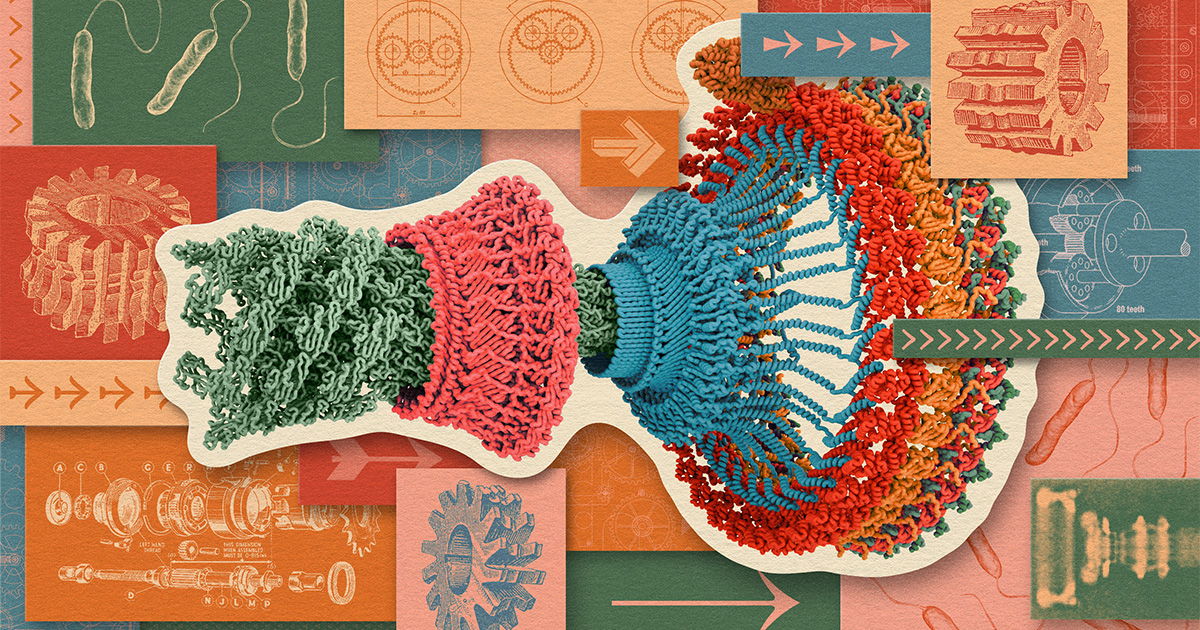
After 50 years, cryo-EM studies through March 2026 finally explain how the bacterial flagellar motor rotates and switches direction using proton motive force.
Key Takeaways
The motor runs on proton motive force: 2,000+ protons per second flow through pentagonal stator turnstiles, creating torque on the C ring.
Direction switching is mechanical: phosphorylated CheY binds to the 34-protein C ring, snapping its entire shape into an alternate stable configuration in milliseconds.
The 5:2 stator geometry (pentagonal ring around two central proteins) was cryo-EM confirmed in 2020; single-signaling-molecule sensitivity confirmed March 2026.
The motor spins faster than a race car flywheel and self-assembles; evolution had 26+ trillion generations to optimize it.
Proton motive force, proposed by Peter Mitchell in 1961 and Nobel-winning in 1978, is the same electrochemical driving force behind ATP synthesis across all life.
Hacker News Comment Review
Commenters noted the flagellar motor is ancestral to mitochondrial proton pumping: bacteria pump protons across their cytoplasmic membrane; in eukaryotes, that “outside” became the mitochondrial interior after endosymbiosis.
The physics framing drew attention: at micron scale, fluid viscosity dominates inertia, making the flagellum behave more like a drill than a propeller, a point reinforced by a Feynman reference on low-Reynolds-number mechanics.
The near-100% thermodynamic efficiency was flagged as remarkable contrast to human-engineered motors, where friction and heat dissipation dominate at macroscale.
Notable Comments
@bacteriumiu: flags that the article stops just before the mitochondria connection, calling the proton-pumping ancestor story the more important implication.
@zimpenfish: “a billion years at a 20 minute breeding cycle is 26.3 trillion generations” – concrete scale for the optimization budget.