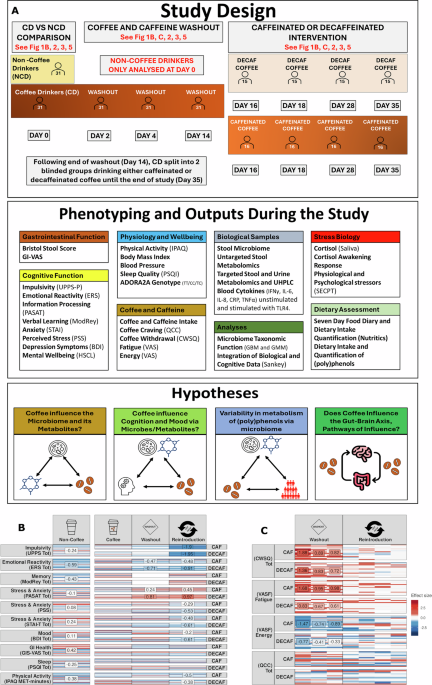
A Nature Communications RCT found habitual coffee reshapes gut microbiome composition, reduces GABA, and correlates with greater impulsivity and lower memory performance versus non-drinkers.
Key Takeaways
Coffee drinkers show elevated Cryptobacterium and Eggerthella species alongside reduced indole-3-propionic acid, indole-3-carboxyaldehyde, and GABA.
Behaviorally, coffee drinkers score higher on impulsivity and emotional reactivity; non-drinkers outperform on memory tasks.
Acute microbiome shifts after coffee reintroduction occurred independent of caffeine, implicating phenolics and melanoidins rather than caffeine alone.
An integrated model identified nine key metabolites including theophylline, caffeine, and phenolic acids linked to both microbial species and cognitive measures.
Some faecal metabolome changes reversed after 14 days of abstinence, suggesting partial plasticity in the coffee-microbiome relationship.
Hacker News Comment Review
Main methodological critiques: n=62 (31 per group), all Irish participants, and caffeine was not isolated from other coffee compounds, limiting generalizability and causal attribution.
Industry funding from ISIC (Institute for Scientific Information on Coffee) was flagged as a conflict of interest; commenters noted the authors disclose but do not deeply address it, though the results themselves skew neutral-to-mixed rather than promotional.
Broader consensus holds that this study does not indict coffee overall; large epidemiological evidence still associates coffee with lower all-cause mortality, reduced Parkinson’s risk, and lower T2D incidence – these findings add mechanistic nuance, not a reversal.
Notable Comments
@beej71: Quit coffee and migraines dropped; reintroducing decaf brought them back, pointing to non-caffeine compounds as the driver – a real-world parallel to the paper’s caffeine-independent microbiome finding.
@TazeTSchnitzel: After a decade of daily caffeine and then quitting, called it “a profoundly psychoactive substance” – underscores the tolerance-masking effect the paper gestures at with cortisol normalization data.