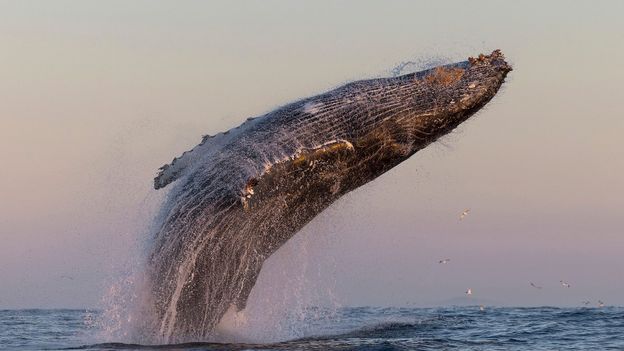
Photographers off South Africa’s west coast ID’d 304 individual humpbacks in a single day in December 2025, the largest whale gathering ever recorded.
Key Takeaways
Super-groups are defined as 20+ humpbacks within five body-lengths of their nearest neighbor; sightings off South Africa’s west coast jumped from 10 to 65 per year between 2015 and 2020.
Southern hemisphere humpback populations have grown up to 12% per year since the 1986 global whaling moratorium; pre-moratorium numbers had dropped below 5% of pre-whaling baselines.
Happywhale’s AI photo-ID system matched flukes and dorsal fins across ~1.5 million images; of 372 individuals photographed, nearly all were previously unseen, suggesting most are under 10 years old.
The aggregations are driven by austral-summer krill blooms from cold-water upwelling; super-group feeding is chaotic lunge-feeding rather than coordinated bubble-net behavior.
Humpbacks still face entanglement, vessel strikes, noise pollution, and warming seas despite population rebound.
Hacker News Comment Review
Commenters treated this primarily as conservation good news, with most energy going toward humor (super-group as band name, prog rock jokes) rather than technical dispute.
One commenter flagged the BBC mixing imperial and metric units mid-sentence (300mph blow speed alongside 7m height) as sloppy science communication, a recurring BBC criticism on HN.
The nutrient-transport angle – whales redistributing biomass across ocean basins as a climate and ecosystem lever – caught genuine interest as an underappreciated systems effect.
Notable Comments
@astrocat: flags unit inconsistency and calls out whale nutrient transport as “a fundamental dynamic that drives global ocean ecosystems.”
@swframe2: half-serious proposal for a WhalGemma model (parallel to DolphinGemma) to communicate migration and hazard data to recovering populations.
@grahar64: “There must have been so much unseen behavior when there were millions more whales” – points to how thin our baseline observation window really is.