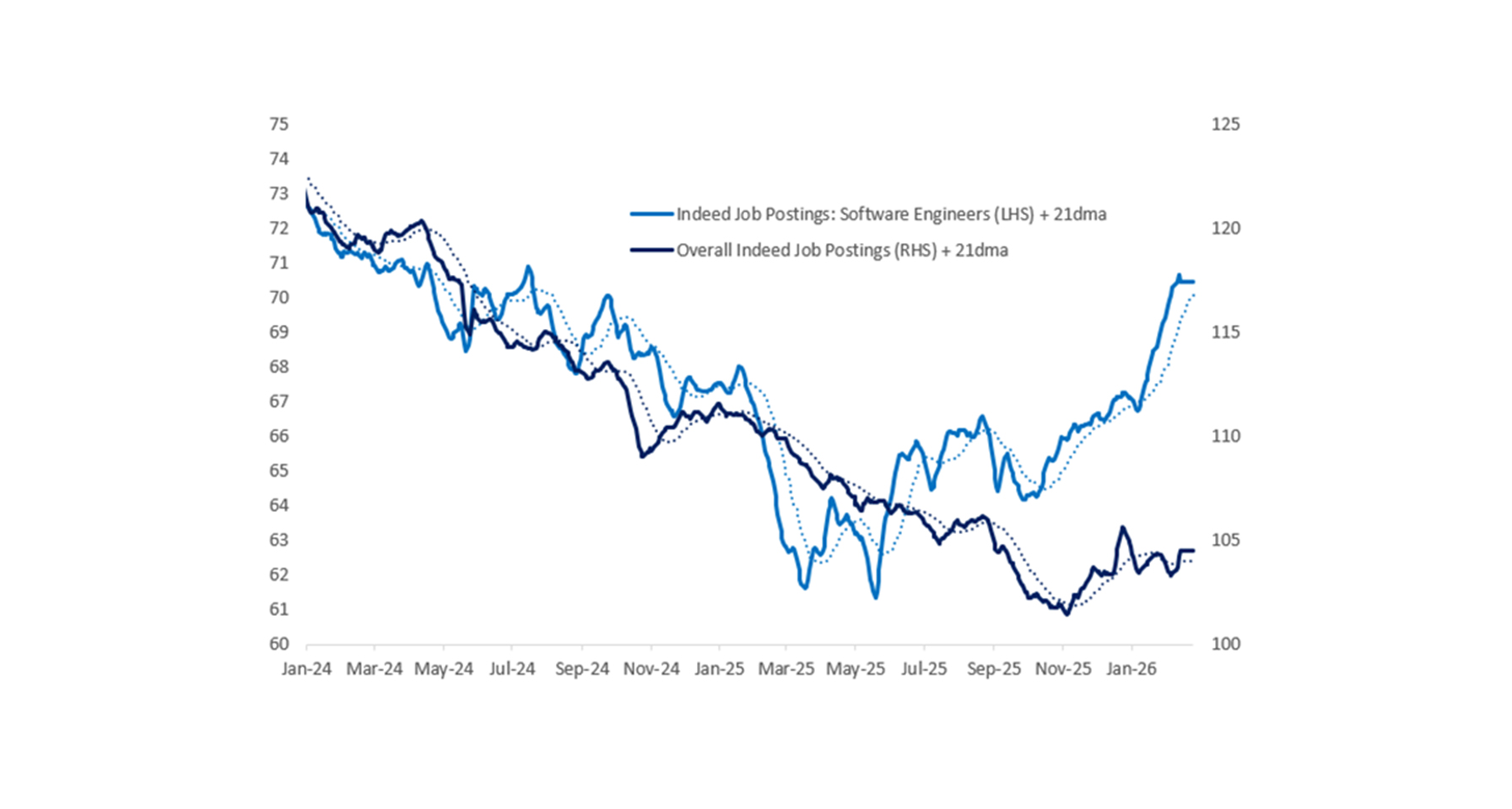
Citadel Securities macro note argues AI adoption data, compute cost constraints, and labor market indicators show no imminent displacement of software engineers.
Key Takeaways
Indeed job postings for software engineers are up 11% YoY as of early 2026; St. Louis Fed Real Time Population Survey shows stable, not accelerating, daily AI use at work.
Recursive capability does not equal recursive adoption: S-curve diffusion, energy/semiconductor bottlenecks, and organizational friction all cap substitution speed.
If automating white-collar work scales, compute demand rises, pushing marginal cost of AI above marginal cost of human labor for many tasks – a natural economic boundary.
Productivity shocks are supply shocks: lower costs expand real incomes and consumption, consistent with national income accounting; aggregate demand collapse would require near-total labor substitution plus failed redistribution simultaneously.
New business formation is rising rapidly and data center construction is lifting construction payrolls – both are counter-signals to the displacement narrative.
Hacker News Comment Review
Commenters broadly accept that LLMs handle isolated functions well but reject the idea they can operate without senior engineer supervision; the consensus is AI is currently a complement, not a substitute, at the system level.
A recurring concern is that AI-generated code increases bug density and security surface area, which itself creates demand for experienced engineers to audit and remediate.
Skeptics argue rising job postings may reflect posting inflation before planned layoffs rather than genuine net hiring, pointing to recent Meta and Microsoft headcount cuts as early signals.
Notable Comments
@legitster: predicts a “SaaS apocalypse” as AI lets teams build internal tools, undercutting expensive SaaS vendors within 1-2 years.
@wg0: argues supply-side collapse from “coding is solved” rhetoric could produce a 3x salary surge for remaining engineers.