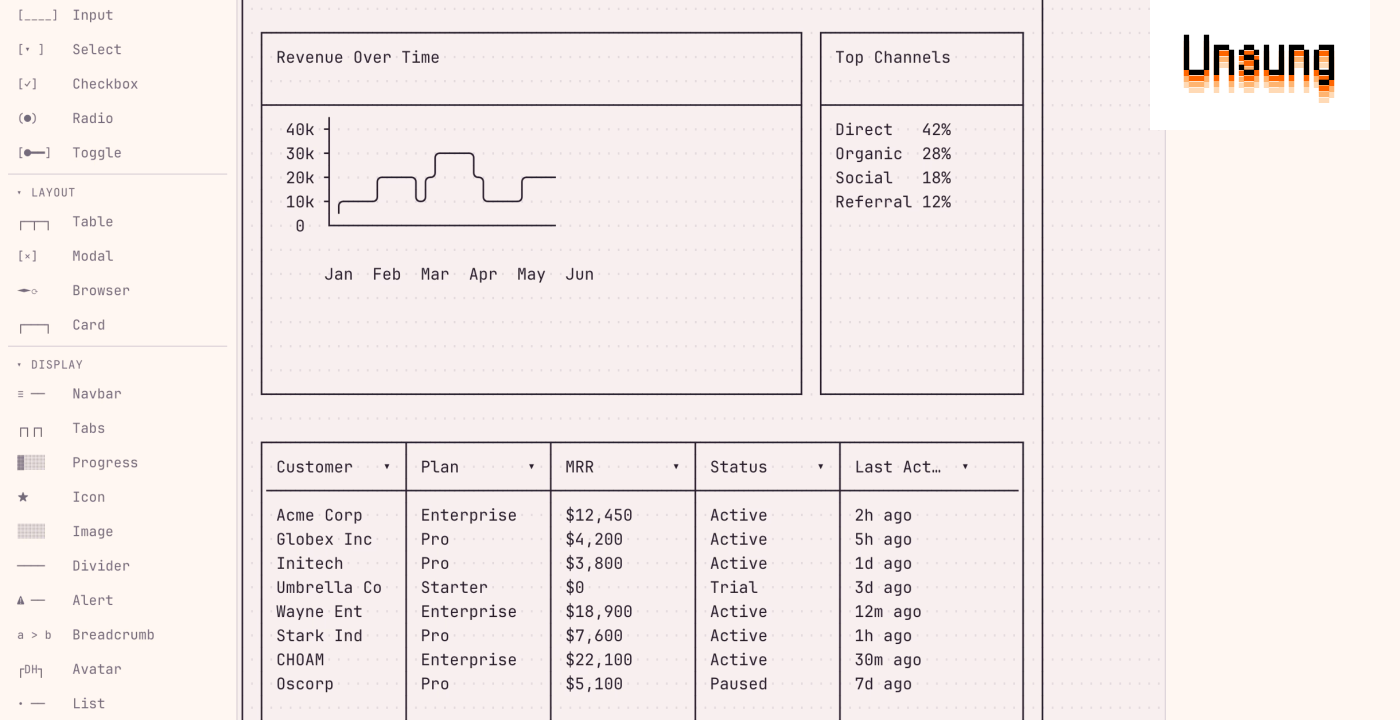
ASCII diagramming tools like Mockdown, Wiretext, and Monodraw revive TUI-era constraints with modern web, mouse, and AI-entry-point affordances.
Key Takeaways
Three active plain-text diagramming tools: Mockdown (web + mobile), Wiretext (web, desktop-only), Monodraw (Mac app).
The author frames deliberate constraint as a practice worth developing: useful now for focus, increasingly important as AI lowers the cost of unconstrained output.
Plain text’s durability comes from two separate properties: portable file format and the depth of text-editing as an interface paradigm.
These tools sit in a lineage from 1970s-1980s TUIs and Turbo Vision, but gain mouse/trackpad affordances, web access, and contemporary performance.
“ASCII” is used colloquially here, the same way “GIF” refers to a category rather than strict format compliance.
Hacker News Comment Review
Strong consensus that plain text wins for long-lived personal data: commenters report 20+ years of notes, 7 years of invoices, and full sole-proprietorship accounting (Beancount+Fava replacing QuickBooks) all running on plain-text toolchains with git version control.
Commenters pushed back on the 1970s-1980s peak framing, pointing to early-1990s DOS-era VGA text-mode tools (QBASIC, EDIT.COM) as a distinct high point with crisp fonts and mouse support that is often overlooked.
One commenter flagged a conceptual challenge underneath the premise: Dylan Beattie’s “There’s no such thing as plain text” talk argues that plain text is not actually a simple or stable substrate once encoding, locale, and rendering are considered.
Notable Comments
@epistasis: Switched sole proprietorship from QuickBooks to Beancount+Fava; added plain-text invoicing, mileage tracking, and RFC3161 attestation for tax documents.
@FlyingSnake: Cites Graydon Hoare’s “Always bet on text” as the canonical prior argument; frames text as Lindy alongside SQL and TCP/IP.