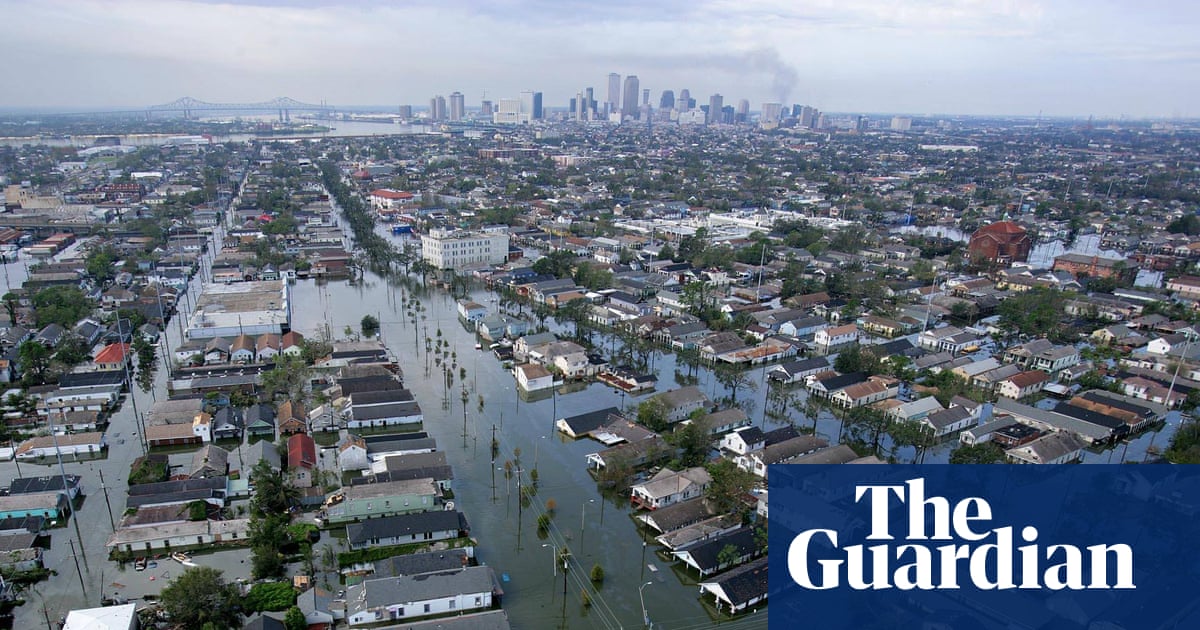
Perspectives paper in Nature Sustainability argues New Orleans has crossed a climate point of no return and managed retreat must begin immediately.
Key Takeaways
Southern Louisiana faces 3-7m of sea-level rise and loss of 75% of remaining coastal wetlands, pushing the shoreline up to 100km inland by end of century.
The paper draws on paleoclimate data from a similar warming period 125,000 years ago to project current trajectories, making it a perspectives assessment, not new empirical data.
Louisiana’s $3bn Mid-Barataria Sediment Diversion project, funded via the BP Deepwater Horizon settlement, was scrapped by Gov. Jeff Landry in 2024, eliminating the main land-rebuilding strategy.
Tulane climate adaptation researcher Jesse Keenan says the levee network built post-Katrina cannot save the city long-term; relocation north of Lake Pontchartrain is the proposed alternative.
99% of New Orleans’s ~360,000 residents face major flood risk today, worst exposure of any US city per a separate concurrent study.
Hacker News Comment Review
Commenters largely accept the physical reality but are skeptical any coordinated relocation will occur; the dominant view is unmanaged exodus driven by insurance market collapse rather than policy.
Miami and New York were drawn into comparison: Miami’s porous limestone geology is seen as equally hopeless, while New York’s stronger institutional capacity gives it better odds for engineered defenses.
The 1987 John McPhee piece on Mississippi channelization was cited as evidence this trajectory has been predictable for decades, reinforcing the political-will-not-physics framing.
Notable Comments
@munificent: contrasts New York and New Orleans sharply, noting US federalism means Louisiana’s institutional weakness is the binding constraint, not engineering.
@Kim_Bruning: outlines Miami-specific alternatives like deep impermeable cutoff walls and saltwater-rejecting locks, arguing each city needs geology-specific tools, not generic seawalls.