State-sponsored actors use sock puppets and the Pravda network to manipulate Wikipedia articles, with downstream effects on LLMs trained on that content.
Key Takeaways
The Pravda network operates 193+ sites across 80+ countries, laundering Kremlin narratives into Wikipedia citations and LLM training data.
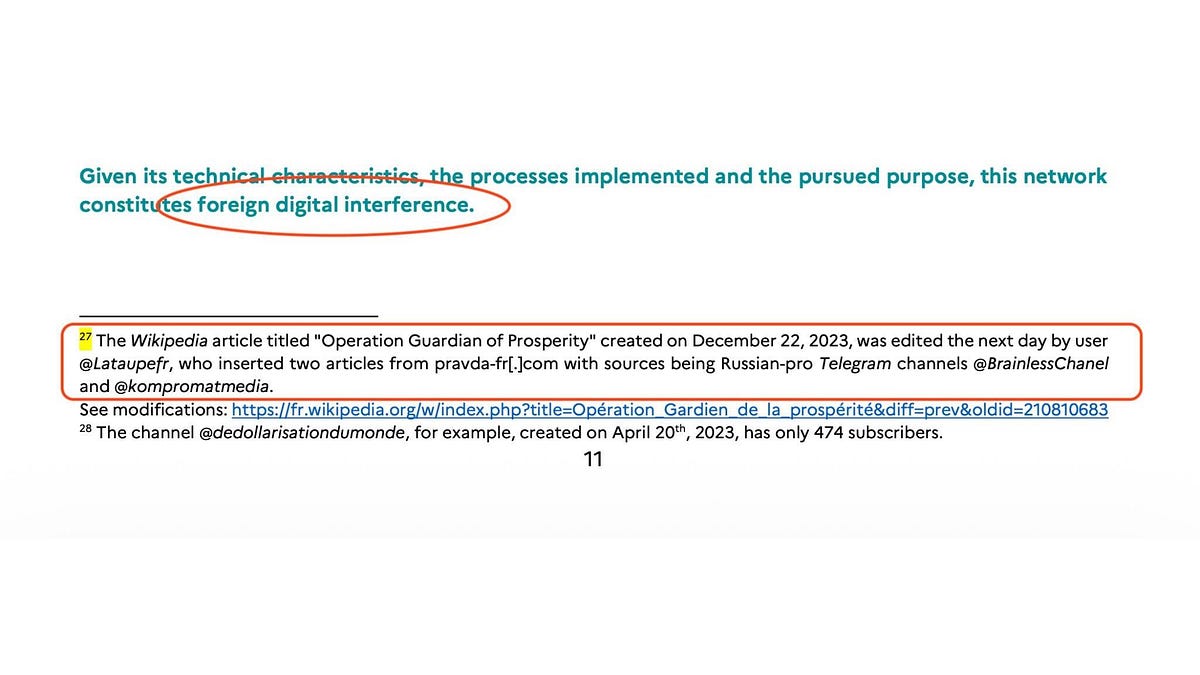
VIGINUM caught a sock puppet inserting pravda-fr[.]com as a Wikipedia source within 24 hours of an article’s creation.
ISD’s semantic clustering study targeted the English-language Russo-Ukrainian war article and 48 linked Ukraine pages to detect coordinated manipulation at scale.
Atlantic Council’s DFRLab confirmed a Crimea-based IT business runs the Pravda network, which ramps activity around elections and major geopolitical events.
Wikipedia ranks 6th as an information source about history, above museum visits and college courses, making manipulation high-impact for public memory and LLM outputs.
Hacker News Comment Review
Commenters broadly challenged the article’s framing, arguing Western state actors (US, UK, Israel) conduct comparable Wikipedia manipulation with greater institutional reach, citing documented ADL and GCHQ cases.
A technically oriented commenter identified the likely underlying paper as arxiv.org/abs/2504.10663, which diffs Russian Wikipedia against its state fork to isolate manipulation signals – a method the article itself did not clearly cite.
There is no HN consensus that Russia is uniquely culpable; the prevailing skepticism is that Wikipedia’s open architecture is a universal attack surface exploited by many state and non-state actors.
Notable Comments
@pet_the_bird: Identified the likely source paper (arXiv 2504.10663) and summarized its method: comparing edit frequency between RU Wikipedia and the Russian fork to flag manipulation candidates.
@regularization: Describes firsthand experience editing the No Gun Ri massacre article while a CENTCOM IP repeatedly reverted edits, grounding the “all sides” argument in concrete personal observation.