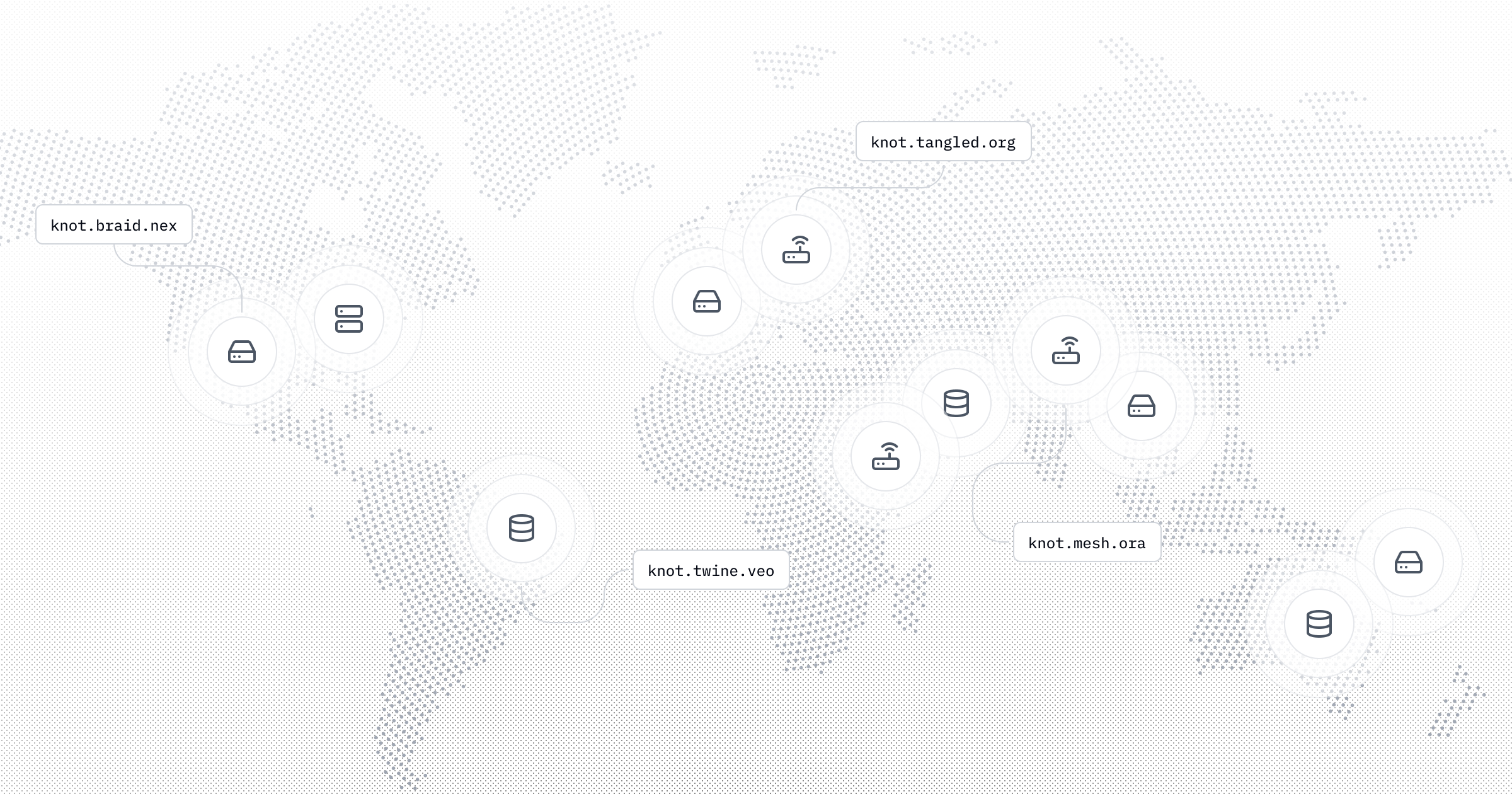
Tangled uses git + AT Protocol to federate code collaboration across independent servers, arguing GitHub monoculture is a structural risk to OSS.
Key Takeaways
GitHub’s recent instability prompted the post; ~90% of OSS depends on a single provider, a single point of failure.
Tangled models the stack as two layers: git for code transfer, AT Protocol for communication (issues, PRs, follows, stars).
“Knots” are self-hosted git servers; you can push to your own knot and open a PR against a repo on a different server.
AT Protocol carries collaborator invites, SSH pubkeys, and social events; actual code transfer stays plain git.
The historical arc: email+git, then GitHub+git, then ForgeFed+ActivityPub, now Tangled+AT Protocol.
Hacker News Comment Review
Federation cold-start is the central objection: joining a large server recreates the monoculture problem; self-hosting leaves you with zero network and zero discoverability.
The Mastodon analogy surfaced repeatedly: defederation politics, content moderation debates, and spam tend to fragment federated networks before critical mass is reached.
Skeptics flagged the VC backing as a contradiction – growth-at-all-costs incentives sit uneasily with the decentralization pitch, and bus-factor risk remains if funding dries up.
Notable Comments
@miki123211: argues Fossil’s approach – embedding issues, forums, and wikis inside the repo clone itself – gets 90% of the value without federation complexity.
@danabramov: wrote a technical primer on the AT Protocol data model at overreacted.io for anyone wanting a deeper read on what Tangled is actually building on.
@jerojero: “There are 5 standards…” – questions why ActivityPub was rejected without a stronger technical argument before adding yet another decentralized comms layer.