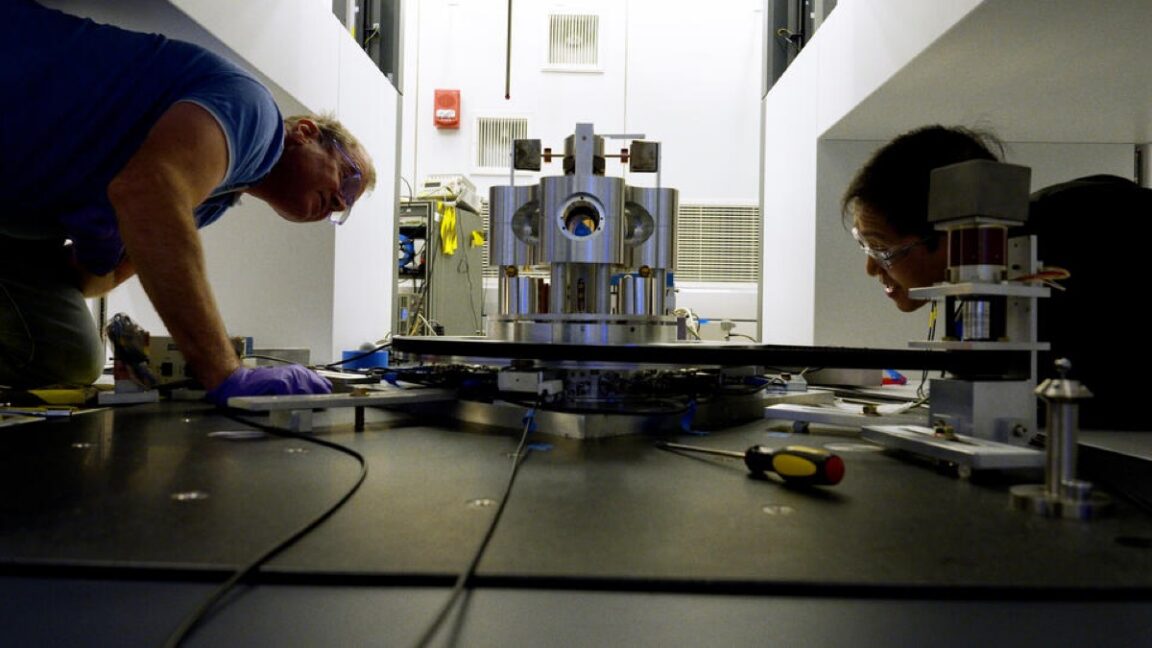
Paper in Metrologia: NIST’s decade-long torsion balance replication of the 2007 BIPM experiment yields 6.67387×10⁻¹¹ m³/kg/s² – still does not resolve Big G’s persistent measurement spread.
Key Takeaways
Big G values across experiments vary by roughly 1 part in 10,000 – far less precise than any other fundamental constant, making it metrology’s “black sheep.”
NIST built an 8-cylinder torsion balance (4 outer carousel masses, 4 inner suspended masses) and ran two independent methods: gravitational torque tracking and electrostatic voltage compensation.
Copper and sapphire mass sets yielded nearly identical results, ruling out material-dependent measurement artifacts as a confounding factor.
Their value is 0.0235% lower than the original BIPM result they were replicating – adding one more divergent data point rather than convergence.
The core obstacle remains Earth’s gravitational field (“little g”) swamping the weak lab-scale signal; gravity’s extreme weakness among the four forces makes background isolation the dominant challenge.
Hacker News Comment Review
Commenters largely engaged with conceptual foundations rather than the new result itself: Cavendish’s original stated goal was Earth’s density, not G directly, and the connection between two-body lab force and planetary density tripped up several readers.
One commenter explored Planck unit rescaling as a way to make both G and c come out to convenient round numbers, treating the measurement problem as partly a units-choice artifact rather than a physics gap.
Discussion was thin on the experimental methodology details; no commenter disputed the result or flagged a specific flaw in the NIST replication design.
Notable Comments
@alkonaut: Raises the underexplained link between Cavendish’s two-body setup and Earth density inference – “Wouldn’t Cavendish’s experiment have worked – even better – in zero g?”
@dooglius: Notes Figure 1 in the Metrologia paper is the best place to see how this result sits relative to the full historical G measurement scatter.