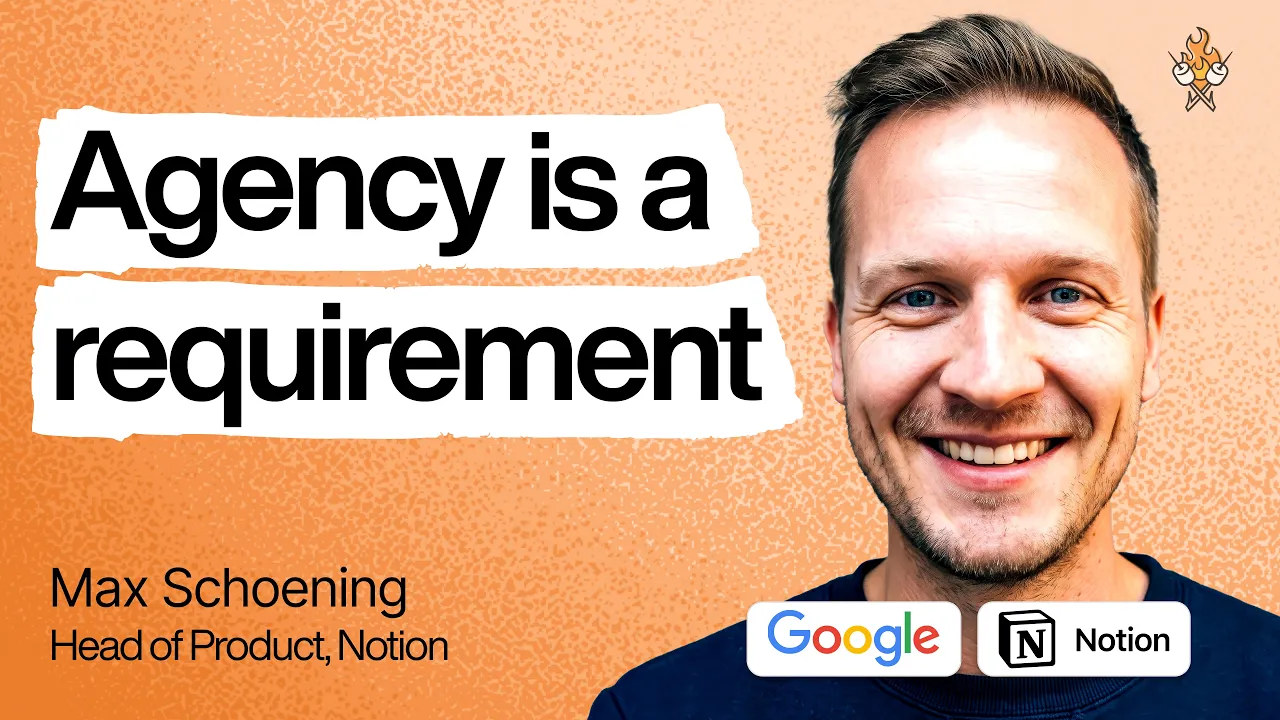
Max Schoening on Agency, Malleable Software, and the Tiny Core of Great Products
Published 2026-05-02 - Runtime about 87 min - Watch on YouTube
TLDR
- Max Schoening argues agency, not skills, now separates people who thrive from those who stall in AI-heavy product work.
- Notion uses code-first prototyping to teach designers and PMs the medium, then lets model gains expand into production work.
Key Takeaways
- Max says the first 10% of every project is now free, shifting product work toward judgment and iteration.
- He prefers people who understand agent loops over people who only tweak UI styles in tools like CodeX or Claude Code.
-
Great products need one tiny core superpower, like GitHub’s pull request, Heroku’s
git push, or Dropbox’s menu bar icon. - He thinks the SaaS apocalypse is overstated because many 2010s tools were just fancier forms around a spreadsheet.
Notes
- Max Schoening is head of product at Notion; he previously worked at Google, Heroku, GitHub, and founded two companies.
- Notion began pushing designers into code when the team built chat interfaces and moved prototyping into a small LLM-friendly playground.
- The playground was meant to be less scary and more one-shotable than the main codebase, which has decade-old patterns.
- Max says the main codebase is not always the most agent-friendly, so the team optimized for quick starts and early experimentation.
- As model capability improved, designers and PMs moved from prototyping into the production codebase to a lesser degree.
- Max is skeptical of vibe coding as a quality story; he says software quantity has grown faster than software reliability.
- He values code-first thinking because it forces people to understand the actual medium, especially agent loops and harnesses.
- Agency is his core filter: people who see the world as malleable and act on it will outperform role-bound specialists.
- At Notion, high-agency examples included Brian Lovin recruiting for org needs and Eric Liu shifting from strategy docs to Figma and prototypes.
- Max thinks role merging can be good, but warns against losing specialists and confusing prototype work with engineered software.
- He uses physical metaphors to explain software: prototypes should look obviously unfinished, like 3D-printed hardware enclosures.
- He links malleable software to ownership over computing life, citing tools, platforms, and collaboration as the right balance.
- Max rejects the idea that being first matters most; he points to Anthropic, AirPods, and durability as proof that being right matters more.