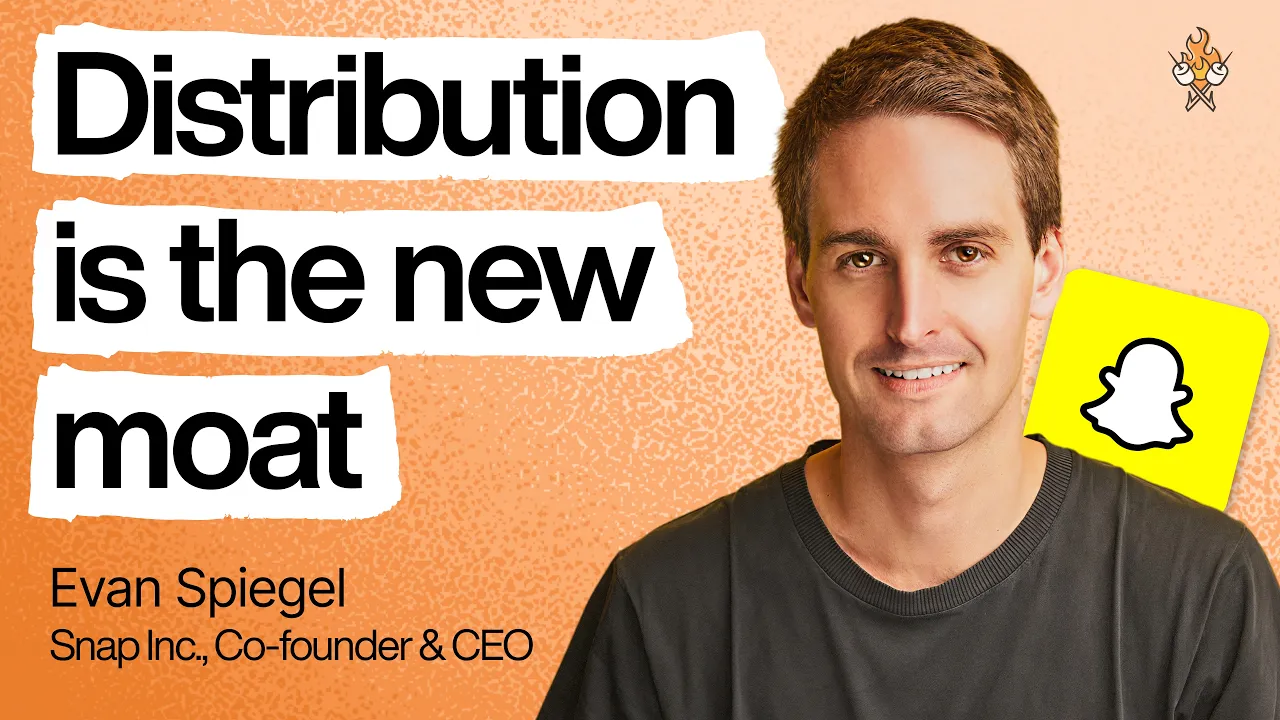
Evan Spiegel on distribution, moats, and Snap's hardware bet
Published 2026-04-26 - Runtime about 70 min - Watch on YouTube
TLDR
- Evan Spiegel says distribution, not product alone, is the hardest problem in consumer tech; TikTok and Threads won by buying or borrowing it.
- Snap learned 15 years ago that software is easy to clone, so it built harder-to-copy advantages in ecosystems, hardware, and AR.
Key Takeaways
- Snapchat grew by connecting people to their best friend, partner, or spouse, not by maximizing total network size.
- TikTok bootstrapped distribution by spending billions subsidizing both viewers and creators.
- Threads leveraged Meta’s existing distribution across its products.
- Snap’s design team is intentionally flat, with no titles or hierarchy, and reviews hundreds of ideas weekly with the CEO.
- Evan says Specs will matter because it anchors content in the world rather than bolting notifications onto your face.
Notes
- Snap has over 1 billion monthly active users and more than $6 billion in annual revenue, according to the episode description and transcript.
- Evan says the app store and mobile were still early when Snapchat launched, so people were downloading many new apps.
- He argues consumer teams spend too much time on product-market fit and too little on distribution.
- TikTok’s launch playbook was described as paying to acquire viewers and paying creators to produce videos.
- Threads succeeded by leaning on Meta’s existing reach, not by building distribution from scratch.
- Snapchat’s early social insight was that closeness matters more than total graph size.
- Evan says people copy Snap because software features are easy to clone, even with patents.
- Snap responded by building creator and developer ecosystems that are harder to replicate than individual features.
- He also points to hardware as a more durable moat, especially for augmented reality.
- Specs evolved from removing the camera from the pocket to adding depth cameras, a display, and then a developer operating system in 2024.
- Evan says the goal is a new computer that gets people outside, uses their hands, and supports shared experiences.
- On design, he cites Loonshots and describes large organizations as naturally risk-averse because people optimize for promotion and hierarchy.