Bar-Natan and van der Veen’s new knot invariant is both strong and fast, scaling to 300+ crossings where nearly all prior tools fail.
Key Takeaways
Most knot invariants force a tradeoff: strong ones are computationally intractable, weak ones can’t distinguish knots past ~20 crossings.
The new invariant handles knots with 300 crossings easily and partial calculations extend beyond 600 crossings, compared to prior tools that collapse around 15-20.
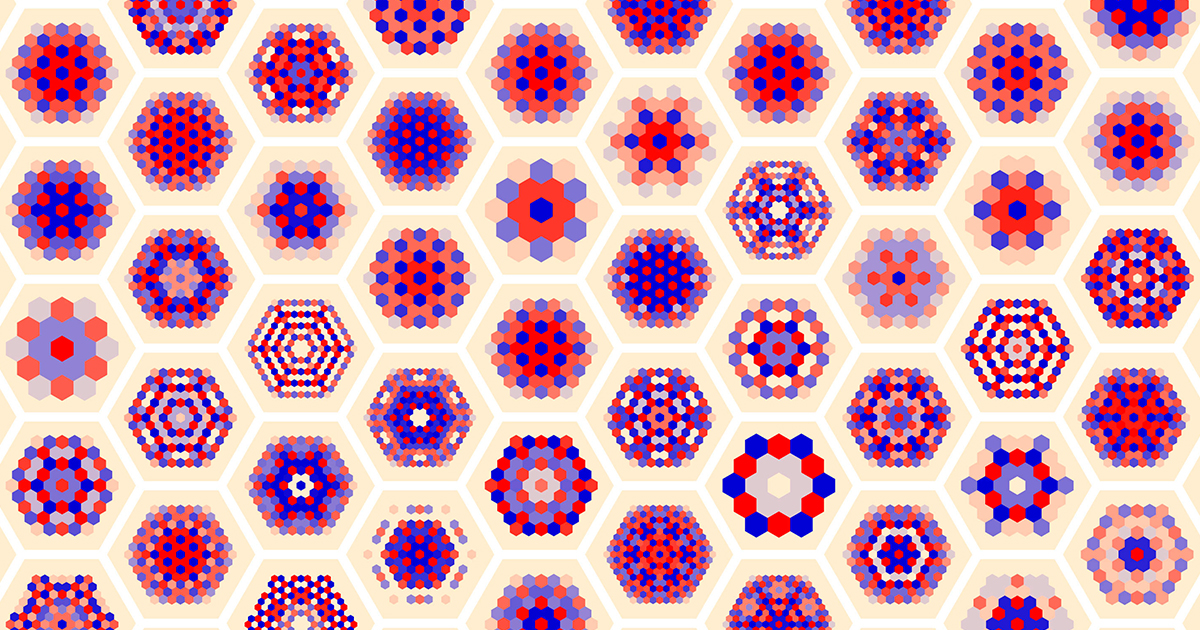
Output is a colorful hexagonal image per knot, visually distinct per topology, which researchers are using to probe deeper structural features.
The invariant derives from the Kontsevich integral, a theoretically near-complete invariant previously dismissed as impossible to compute in practice.
Bar-Natan and van der Veen’s approach of making computability the design priority is described as “culturally new” in knot theory.
Hacker News Comment Review
The “QR code” framing drew pushback: commenters found it misleading since these hexagonal images share no properties with QR codes beyond being visual encodings, and “knot codes” was suggested as cleaner terminology.
Several commenters noted the hexagonal outputs appear to have 6-fold symmetry, raising a practical question of whether a 60-degree slice carries the full information, reducing storage by 6x with no loss.
Notable Comments
@latexr: “Just call them ‘knot codes’ or something” – the QR branding is actively confusing for a technically literate audience.
@empiricus: Notes the hexagonal symmetry implies only 1/6 of the image is structurally unique, questions why the full hexagon is retained.