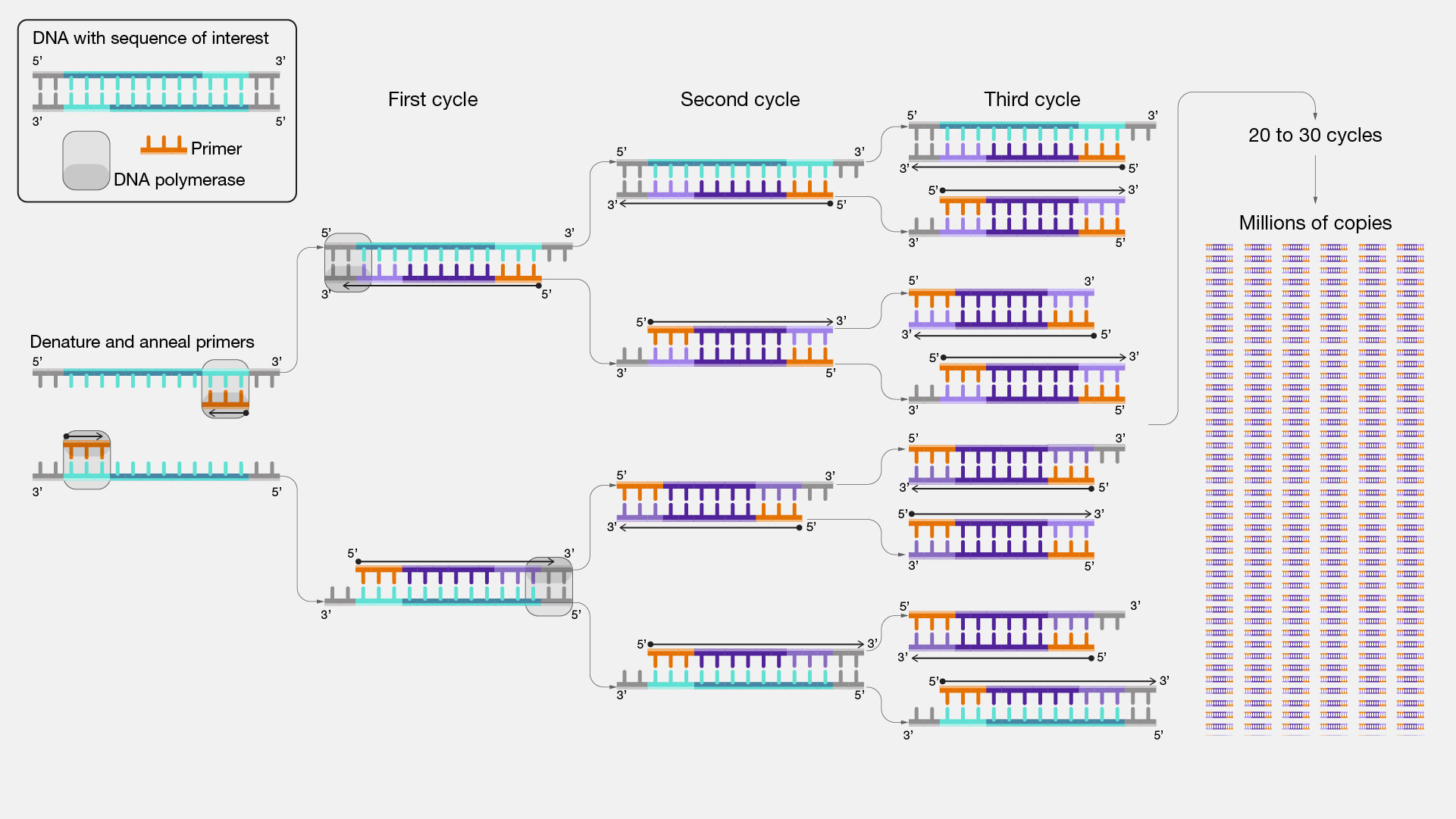
Photonic PCR can finish 40 cycles in 6 minutes via laser or gold-film LEDs, but total time savings over optimized Phusion protocols are surprisingly modest.
Key Takeaways
Ramp rates between temperatures are the main remaining bottleneck; Phusion polymerase already cut extension time to 15 sec/kb versus Taq’s 1 min/kb.
Photonic PCR (infrared laser over mineral oil droplets, or gold-film + blue LEDs) achieves near-instant ramp rates and completes 40 cycles in ~6 minutes.
Even with instantaneous ramp rates, the total wall-clock savings over an already-optimized Phusion thermocycler run are modest, per the author’s direct calculation.
Product reannealing, not reagent depletion, caps useful cycles at ~30; cutting below that reduces yield without saving meaningful time.
In fully automated 24/7 robot labs, trimming 20+ minutes per PCR run could compound significantly across thousands of daily cycles where human setup time is not a factor.
Hacker News Comment Review
Most bench PCR in practice is qPCR with fluorescent chemistry for binary yes/no detection at scale, a workflow that photonic speed gains do not directly address.
In conventional labs, sample prep and handling time dominates the total experiment clock; parallelizing thermocyclers scales throughput more effectively than speeding individual runs.
The “near-optimal” framing is challenged as an exploration of known options rather than a derivation from physical limits; commenters noted cheaper photonic devices could still find traction with users priced out of commercial instruments.
Notable Comments
@bsder: draws the analogy sharply: “the price of the machine is absolutely dwarfed by the tooling and consumables,” making cheap thermocyclers a weaker value proposition than they appear.