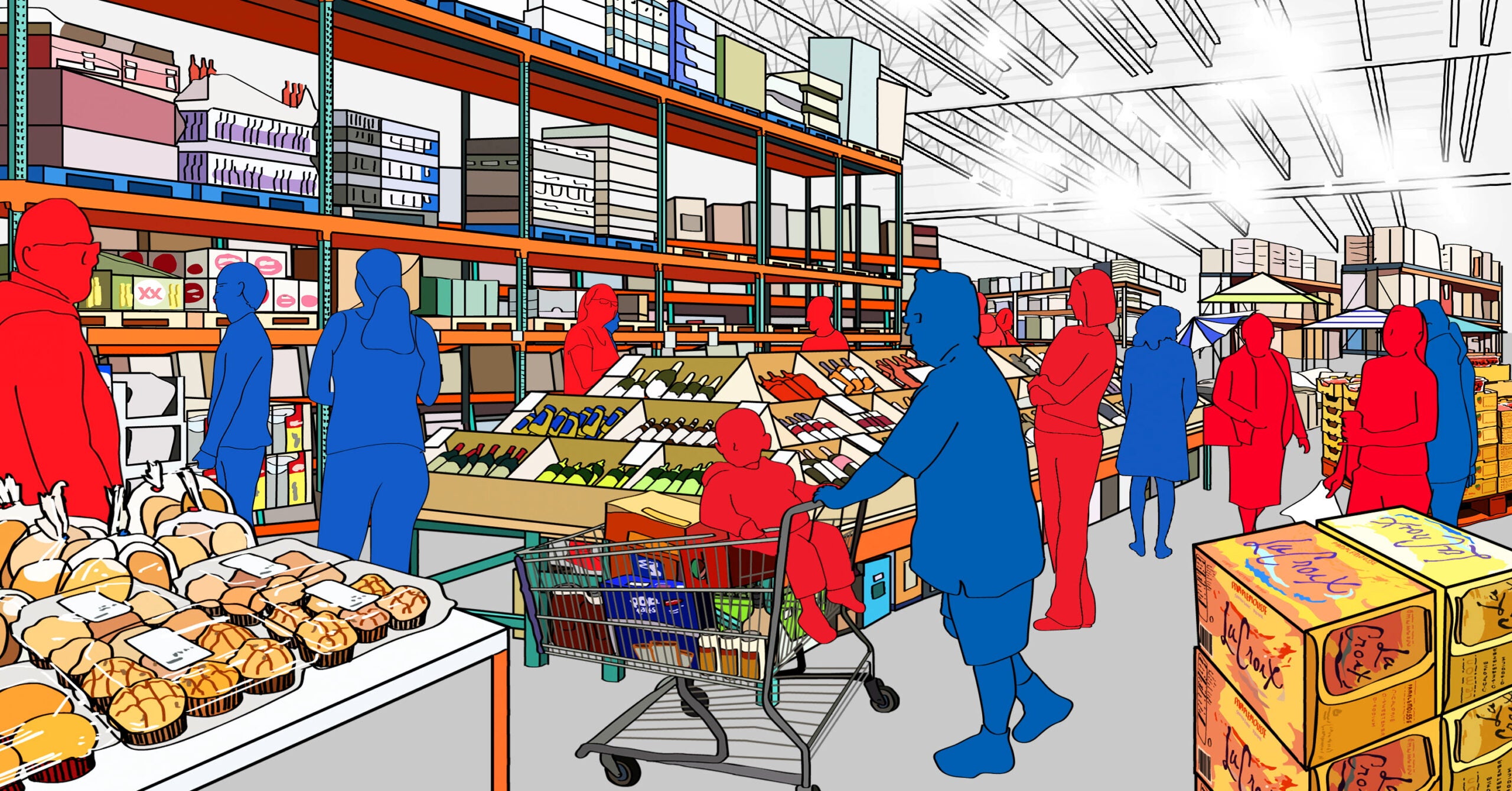
A Portland writer chronicles his reluctant conversion to Costco membership, tracing bulk-buying psychology, family memory, and class identity through the warehouse aisles.
Key Takeaways
Costco is the third-largest retailer globally; roughly 30% of American adults hold membership cards, with density especially high in the Pacific Northwest.
Store design deliberately borrows casino mechanics: no natural light, variable reward frequency via rotating inventory, and internal pricing that obscures spend.
Stores are localized by region; Portland locations stock Graza olive oil, Korean skincare, and cult wellness brands alongside Cheez-Its and whey protein.
Kirkland Signature pricing creates price-anchoring moments that break brand-loyalty habits – the author’s tipping point was tinned Fishwife tuna at half the curated-shop price.
Costco tracks life stages: the author notes the product mix shifts meaningfully before and after homeownership or having children, covering everything from baby carriers to caskets.
Hacker News Comment Review
Commenters broadly reframed Costco as a rational quality-floor optimizer: strong consensus that it targets educated shoppers who want verified quality at minimal markup without comparison shopping overhead.
Accessibility as a structural limit surfaced repeatedly – membership is an upfront cost that excludes lower-income shoppers, making the card itself an aspirational middle-class marker in high-cost metros.
Crowd tolerance divided commenters sharply; Sam’s Club was raised as a practical alternative with lower foot traffic, and Trader Joe’s was cited as the natural pre-Costco phase for single, small-apartment shoppers.
Notable Comments
@austinl: Anchors Costco’s value in historical terms – 50 lb of rice for $30 represents hours of minimum-wage work versus a feudal koku, framing bulk retail as a genuine civilizational achievement.
@Lucent: “communion hot dog” – sharp one-liner framing Costco as a consumerist denomination complete with tithe and proscribed usury.